


On "Celebrating Courage"
Our annual gala this year is for “Celebrating Courage” after the year we all just endured. We are honoring José Feliciano and the gala website has many new features worth seeing and enjoying! We thank our sponsors for making this all possible.
Heather Cox Richardson, a history professor at Boston College, is the most successful independent journalist in America, according to Substack statistics. Each day’s installment of “Letters From an American” summarizes the events of the day.
Here is her post for Sunday that speaks to a peer of our namesake, George Washington Carver, and to the meaning of courage as demonstrated by Frederick Douglas.
Frederick Douglass wrote his autobiography three times, but to protect the people who helped him run away from enslavement, he did not explain how he had managed to get away until the last version.
Douglass escaped from slavery in Baltimore, Maryland, in 1838. In his twenty years of life, he had had a series of masters, some kind, some harsh, and one who almost killed him. But by 1838, he was a skilled worker in the local shipyards, earning good money for his master and enjoying a measure of freedom, as well as protection. He had good friends in the area and had fallen in love with the woman who would become his wife.
It was enslavement, but within that existence, it was a pretty good position. His peers in the cotton fields of the Deep South were beaten like animals, their deaths by violence unremarkable. Douglass himself had come close to being "sold down the river"—a term that referred to the slave convoys that traveled down the Mississippi River from older, worn out lands in the East to fresh, raw lands in Mississippi and Louisiana—and he knew that being forced to labor on a plantation in the Deep South would kill him.
His relatively safe position would have been enough for a lot of people. They would have thanked God for their blessings and stayed put. In 1838, Frederick Douglass was no different than they were: an unknown slave, hoping to get through each day. Like them, he might have accepted his conditions and disappeared into the past, leaving the status quo unchanged.
But he refused.
His scheme for escaping to freedom was ridiculously easy. In the days of slavery, free black sailors carried documents with them to prove to southern authorities that they were free, so they could move from northern and foreign ports to southern ports without being detained. These were the days before photos, so officials described the man listed on the free papers as they saw him: his color, distinguishing marks, scars. Douglass worked in shipyards, and had met a sailor whose free papers might cover Douglass... if the white official who looked at them didn't look too closely. Risking his own freedom, that sailor lent Douglass his papers.
To escape from slavery, all Douglass had to do was board a train. That's it: he just had to step on a train. If he were lucky, and the railroad conductor didn't catch him, and no one recognized him and called him out, he could be free. But if he were caught, he would be sold down river, almost certainly to his death.
To me, Douglass's decision to step aboard that train is everything. How many of us would have taken that risk, especially knowing that even in the best case, success would mean trying to build a new life, far away from everyone we had ever known? Douglass's step was such a little one, such an easy one... except that it meant the difference between life and death, the difference between a forgotten, enslaved shipyard worker and the great Frederick Douglass, who went on to become a powerful voice for American liberty.
Tomorrow, my students will graduate, and every year, students ask me if I have any advice for them as they leave college or university, advice I wish I had had at their age. The answer is yes, after all these years of living and of studying history, I have one piece of advice:
When the day comes that you have to choose between what is just good enough and what is right... find the courage to step on the train.
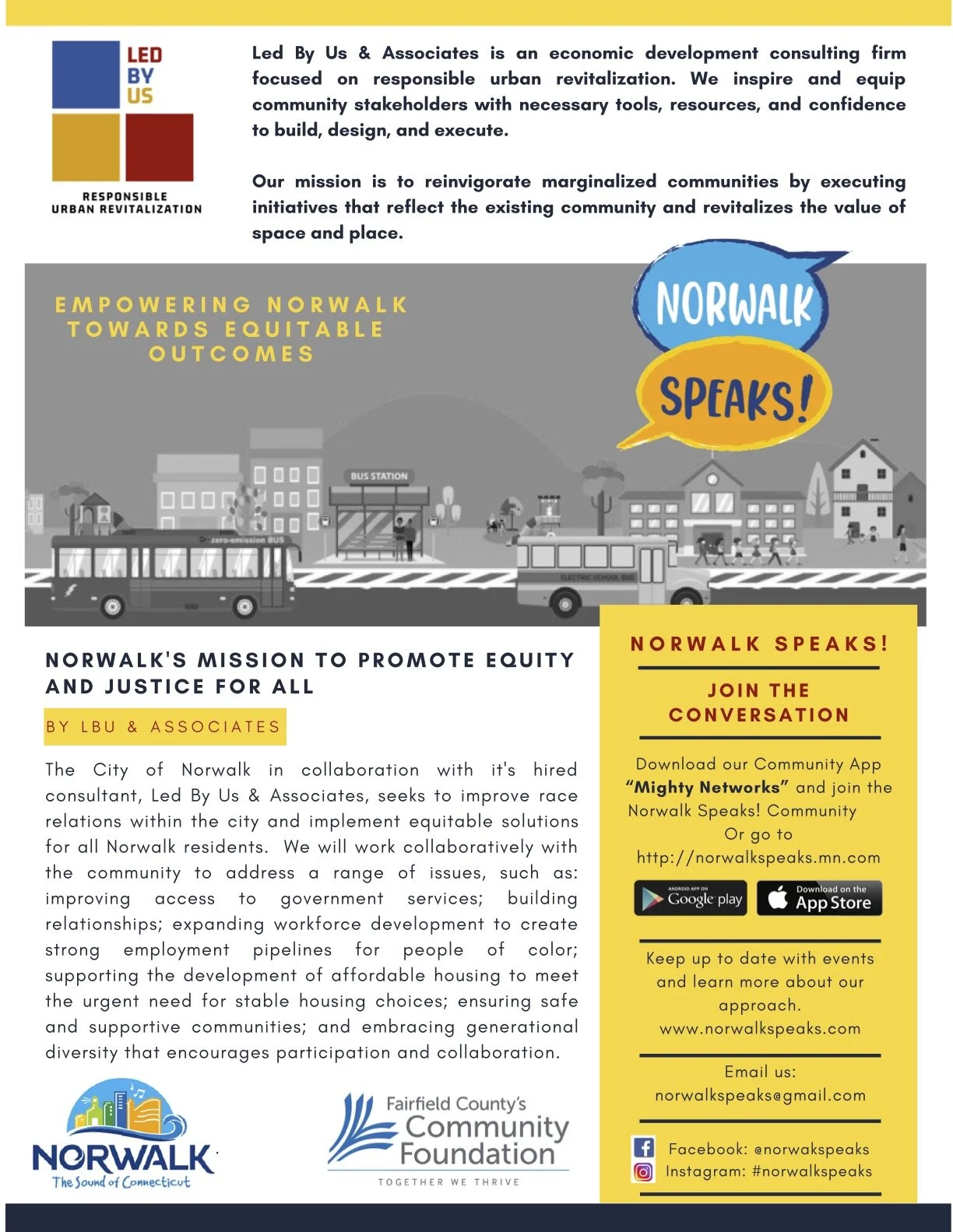
Saturday, 11 AM - 2 PM, the official launch of Norwalk Speaks! at this Community Health Day event

Norwalk End-Of-Year Ceremony Schedule

Our schools have now finalized times and outdoor locations for Grade 8 promotions and graduation ceremonies for the Class of 2021. Schools will be in touch with additional details!
Carver students participating in the Lockwood-Mathews Mansion writing compettion

Carver middle school students recently visited Lockwood-Mathews Mansion in preparation for their participation in the 2021 Lockwood-Mathews Mansion Museum’s Young Writers’ Competition.
The Museum launched its eighth annual Young Writers’ Competition on February 1, 2021. The competition titled, A Scientist Visits the Mansion, will end on June 4, 2021, with an awards ceremony on Sunday, Nov. 21, 2021. The competition is open to all middle school students in the Tristate area.
Participants are tasked to write a story of a fictional event taking place at the Lockwood-Mathews Mansion between 1868 and 1938. The cast of characters must include a doctor or scientist who became famous or infamous during the mid-to-late 19th century and members of the Lockwood or Mathews families.

The young writers will learn about the families’ history, read biographies of the doctors and scientists, and explore the rooms in the Mansion where the event described could have taken place. In addition to Carver students visiting, they can also use the Museum’s website as a reference.
Students will create a short story that will include at least one doctor or scientist weaved into this narrative, and can introduce fictional friends visiting the Mansion as well.
Competition winners and their families will be Guests of Honor at the Awards Ceremony on Sunday, Nov. 21, 2021, 2-4 p.m.
The Lockwood-Mathews Mansion Museum is regarded as one of the earliest and most significant Second Empire Style country houses in the United States. Built by renowned financier and railroad tycoon LeGrand Lockwood from 1864-1868, the Mansion, with its unparalleled architecture and interiors, illustrates magnificently the beauty and splendor of the Victorian Era.

Lockwood’s financial reversal in 1869, and his untimely death in 1872, resulted in the loss of the estate then known as “Elm Park,” through foreclosure, in 1874. In 1876, the property was sold to Charles D. Mathews and his wife Rebecca. Mathews, a prominent importer from New York, and his family, resided in the Mansion until 1938.
In 1941, the estate was sold to the City of Norwalk and designated a public park. When the building was threatened with demolition in the 1960s, concerned citizens galvanized to save the Mansion in one the most important and hard-fought preservation battles in Connecticut’s history. These local preservationists succeeded in saving the Mansion in 1965, and later formed the Lockwood-Mathews Mansion Museum of Norwalk, Inc., a 501(c)(3), which was designated a National Historic Landmark, in 1971.

Second dose at Carver, TODAY, 5/19 11AM - 5PM

Thank you, Wendy & Rich Baskin, for all that you do for the Carver community
Carver Explore students learn robotics at Tracey Elementary School
With the generous financial support of FIRST®, an international robotics community, Carver’s after-school programming incorporates the FIRST® LEGO® League initiative to promote STEM education amongst our students.
Here is a video of our Carver Explore students at Tracey Elementary School working on their robotics project.
First LEGO League promotes STEM learning and exploration while teaching Carver kids the value of teamwork, inclusion, innovation, and discovery. Our elementary students partake in hands-on activities that require them to develop solutions to real-world problems using LEGO bricks and engineering fundamentals. Prior to the pandemic, Carver middle schoolers also participated in FIRST LEGO League’s robotics competitions, which entail building and programming a LEGO robot.
FIRST® is a robotics community that prepares young people for the future. A vital part of our strategic intent is to serve an inclusive and diverse audience, reflecting the population of the communities we serve—and even going beyond through targeted, new community outreach.
FIRST understands the broader societal context of economic, educational, and social factors historically leading to disproportionate access and outcomes. Leveraging cross-sector and industry collaborations, FIRST is actively engaged in developing and delivering strategies that remove barriers and ensure greater access to FIRST programs so that all youth can participate.
Thank you, Roz and Phil Butterfield, for sponsoring our Celebrating Courage gala!
Philip Butterfield is President of Carver’s Board of Directors. Phil is also an engaged leader at Social Venture Partners Connecticut and the former chairman of HSBC Bank Of Bermuda.