
Free Fall Art & Music Classes Are Back at The Norwalk Art Space
For young people who love to draw, paint, create, make music, or simply want to try something new, one of Norwalk’s great free opportunities is back this fall.
The Norwalk Art Space is now registering students for its new Fall Free Education Program, with classes beginning September 28.
Responding to strong demand, The Norwalk Art Space is expanding its free art and music offerings this fall with more classes, more sessions, and opportunities for more students. The fall season will be divided into two four-week sessions, with classes designed specifically for middle school students ages 11–14 and more advanced opportunities for high school students ages 14–18.
Best of all, no prior art experience is required.
Weekly art classes are taught by The Norwalk Art Space’s Resident Artists and visiting artists under the direction of Executive Director Duvian Montoya and Educational Director Darcy Hicks. Additional workshops are offered throughout the year in connection with exhibitions and other activities.
Because these high-quality classes are offered free of charge and space is limited, students should register only if they can attend all sessions of their selected afterschool class. Students interested in a class that is already full can contact The Norwalk Art Space to join the waitlist.
Carver is especially proud of its relationship with The Norwalk Art Space. Some classes and opportunities are reserved specifically for young people participating through community partners, including Carver, the Norwalk Housing Authority, and Family & Children’s Agency.
At Carver, we believe learning happens everywhere—in classrooms, on stages, in studios, in workplaces, and throughout the community. The arts give young people another way to discover their abilities, develop confidence, express themselves, and imagine what might come next.
We encourage Norwalk students and families to explore these outstanding free opportunities this fall.
Classes begin September 28. Registration is open now.
More classes. More students. More creativity. More arts for all.
A September Shoutout for Civic Engagement
Through the Civically Engaged Organization Pledge—which Carver first took several years ago and has renewed annually ever since—the Office of the Secretary of the State encourages organizations across Connecticut to help their communities become informed and engaged participants in our democracy.
This September, the initiative is highlighting something especially important in today’s information environment: the responsibility we all share to slow the spread of misinformation, check claims before sharing them, and rely on trusted sources for election information.
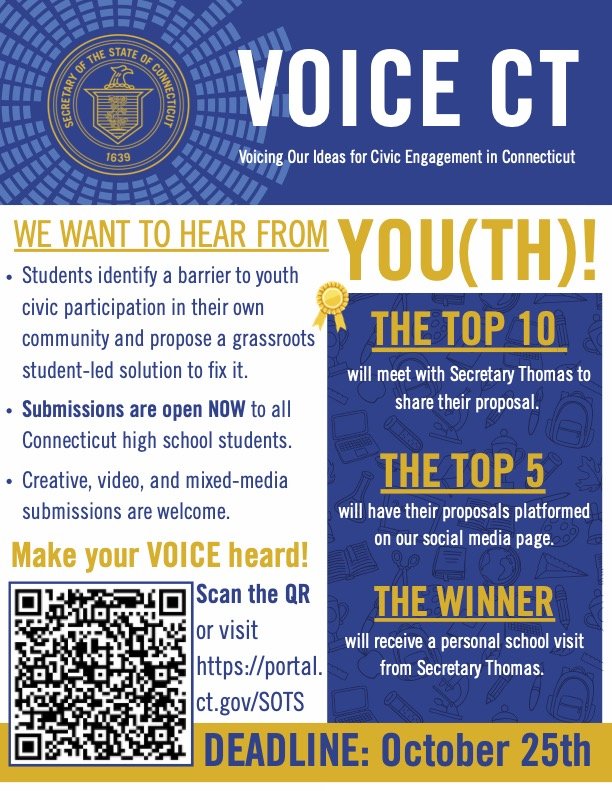
At Carver, we believe preparing young people for the future means more than academic and career readiness. It also means helping them understand that their voices matter and that informed participation in their communities is part of responsible citizenship.
Connecticut residents can find trusted, nonpartisan election and voter information at MyVote.CT.gov.
The Hour After the Bell
At 3:15, Maya has already been in school for most of the day.
She is tired. She is hungry. A math problem in her backpack, she hopes, will somehow disappear before tomorrow morning.
It won't.
Neither will the adults waiting to help her with it.
Maya is a fictional student, but her afternoon is familiar to anyone who works with middle school students. She is old enough to want independence and young enough to need more support than she sometimes wants to admit. She knows when she doesn't understand something. She is also becoming very good at making sure nobody else knows.
So when the school day ends, Maya doesn't announce that she needs help.
She gets a healthy snack. She talks with friends. She opens her backpack slowly. Eventually, the math worksheet comes out.
An adult nearby notices.
"How's it going?"
"Fine."
It is the universal middle school answer.
A few minutes later, they are looking at the problem together.
The Hours That Matter
We tend to measure education by what happens during the school day: attendance, grades, test scores, assignments completed, credits earned.
All of those things matter.
But young people do not stop developing when the final bell rings.
The hours after school are filled with choices. Finish the assignment or put it off. Ask for help or pretend you understand. Try something unfamiliar or stay with what you already know. Spend time with people who expect something of you—or with no one expecting very much at all.
For many young people, those hours can shape what happens when they return to school the next morning.
That is why Carver has always understood education as something larger than a classroom or a school schedule.
Sometimes the Work Looks Ordinary
There is nothing particularly dramatic about Maya's afternoon.
No great breakthrough occurs.
Nobody gives a speech.
She struggles with the problem. Someone asks a question instead of giving her the answer. She tries again. Her friend finishes first and begins talking about something else. Maya gets distracted. She comes back to the worksheet.
Eventually, she gets it.
"See?" the adult tells her. "You knew how to do that."
Maybe she did.
Or maybe what she needed was someone who believed she could figure it out and had enough time to wait while she did.
That distinction matters.
Because much of the work of helping young people succeed looks remarkably ordinary while it is happening.
A teacher stays a little longer.
A student tries one more time.
Someone notices when a child who usually talks becomes quiet.
Someone remembers to ask how yesterday's test went.
A young person discovers that adults are paying attention, not only when something goes wrong, but every day.
From One Afternoon to a Future
One completed math problem will not determine Maya's future.
Neither will one afternoon.
But tomorrow there will be another problem, another assignment, another difficult conversation, another opportunity to quit or continue.
And then another.
Over time, something begins to change.
The student who needed encouragement begins attempting the problem before asking for help. The child who was afraid of being wrong starts raising a hand. The middle schooler who could not imagine high school begins thinking about college. Interests emerge. Confidence grows. Possibilities expand.
That is how much of youth development actually happens: gradually, almost invisibly, through thousands of interactions that rarely seem important enough to remember at the time.
Carver has been part of those interactions for generations of young people.
We are there during the school day and after it, during the academic year and the summer, as elementary students become middle schoolers, middle schoolers become high school students, and young people begin imagining lives beyond graduation.
The programs may differ. The ages change. The challenges become more complicated.
But something essential remains the same.
A young person is trying to figure out what comes next.
And someone is there to help.
At 5:30, Maya puts the worksheet back into her backpack.
Tomorrow morning, it will come out again.
This time, completed.
It is a small victory. Almost nobody will notice it.
We do.
The First Week Is Over. Now the Real Work Begins.
The first week of the 2026–27 school year is in the books.
Across Norwalk, students have found their classrooms, met new teachers, reconnected with friends, and begun settling into the rhythms of another school year. The first-day photographs have been taken. New backpacks are already a little less new. Schedules are becoming routines.
And now the real work begins.
At Carver, back-to-school has never been about a single day. It is about everything that happens in the days, weeks, months, and years that follow.
Throughout the school year, Carver works alongside Norwalk Public Schools, families, teachers, community partners, volunteers, and supporters to surround young people with opportunities to learn, discover, belong, and grow.
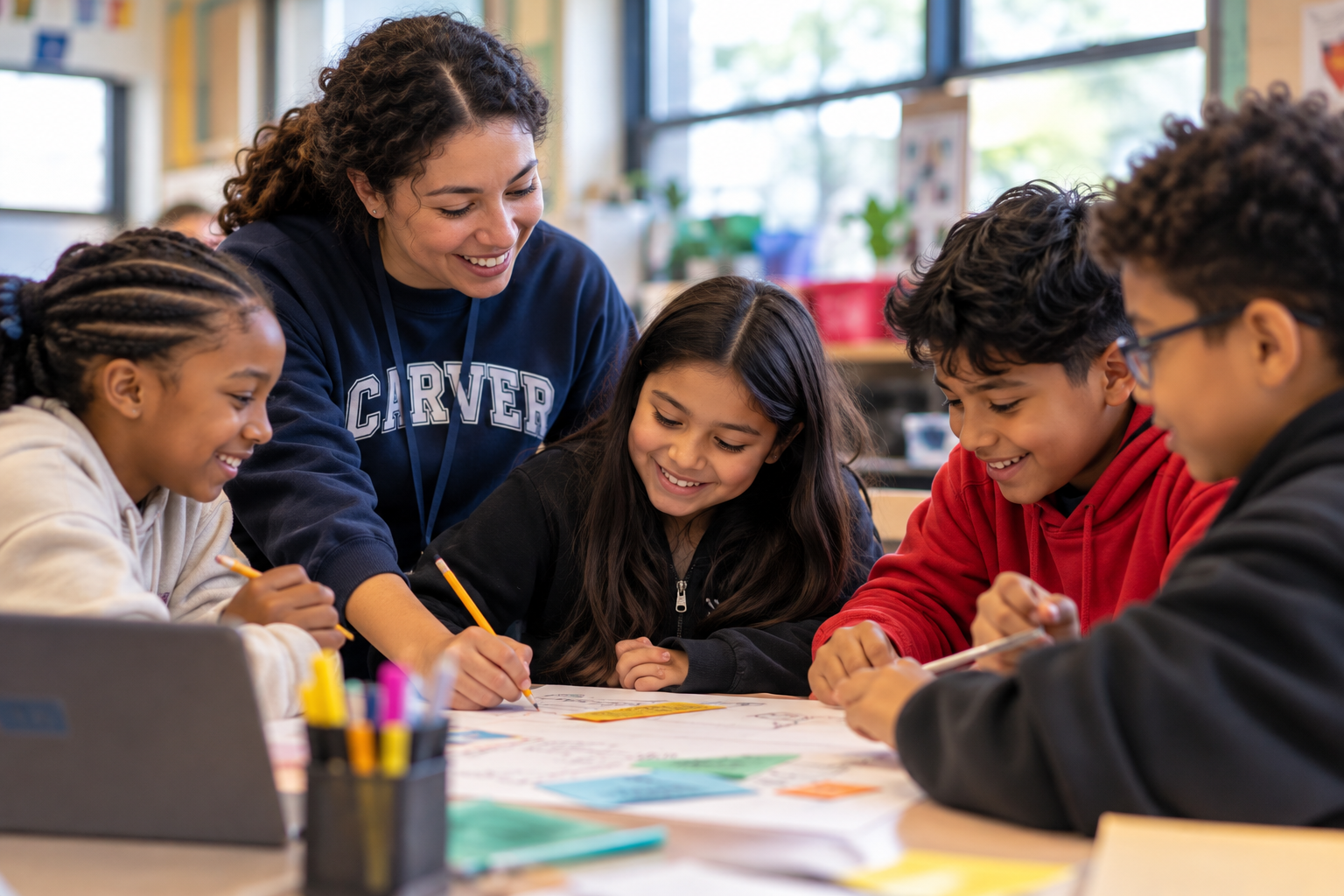
For elementary students, that means productive hours after the final school bell—time for academic support, enrichment, recreation, friendships, and caring adults.
For middle school students, it means continuing to build the academic skills, confidence, curiosity, and independence they will need as the expectations around them grow.
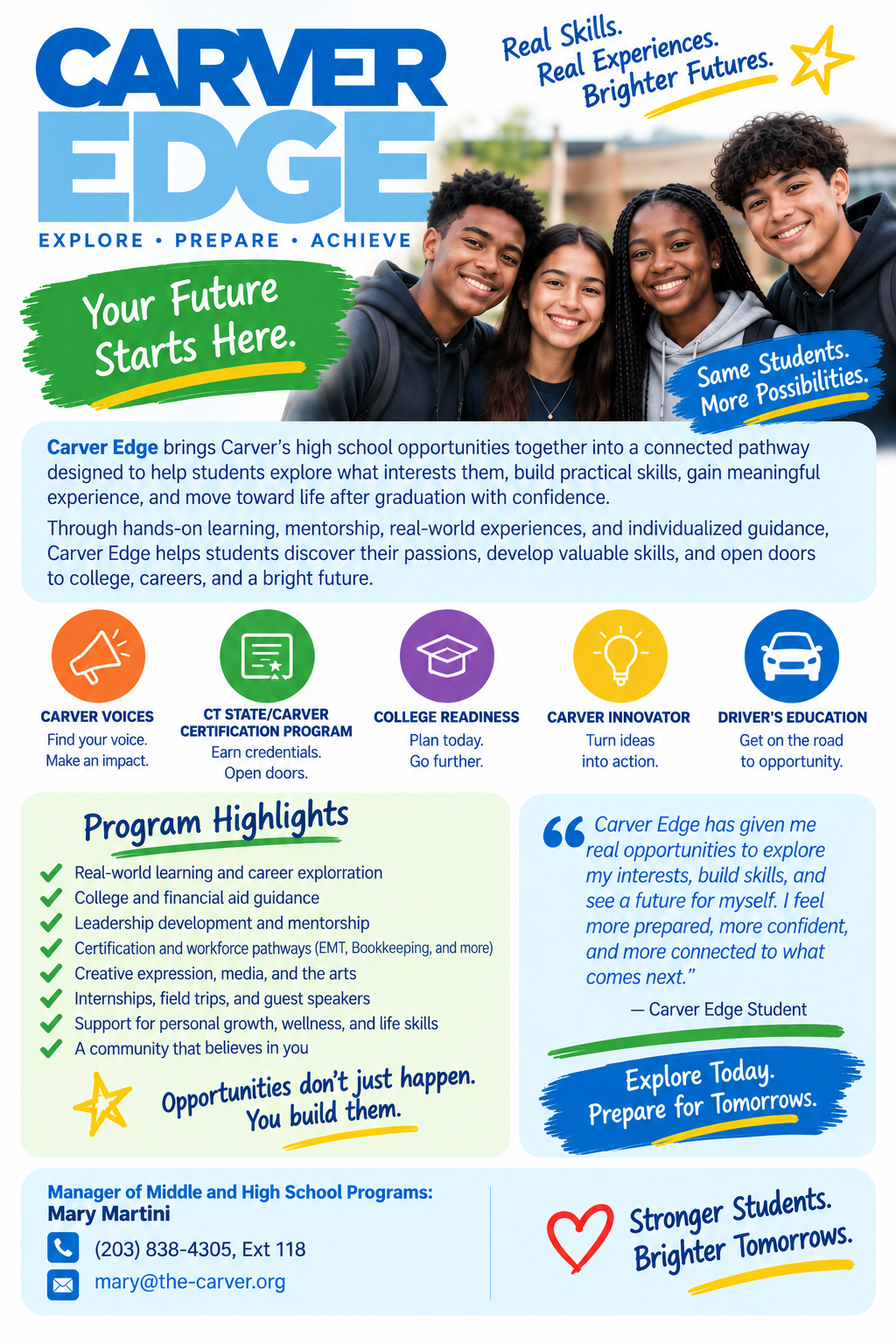
For high school students, the horizon widens even further. College preparation, paid internships, workforce experiences, leadership, the arts, wellness, and new initiatives such as Carver Voices help students begin answering one of adolescence's most important questions: What might my future look like?
No single program or moment answers that question.
A future is built gradually.
It can begin with a teacher who stays a little longer to explain something that didn't make sense the first time. A first trip away from home. A summer internship and a first paycheck. A college visit that suddenly makes higher education seem possible. A mentor who recognizes a talent before a student recognizes it in themselves. A chance to speak, create, lead, compete, explore, or simply discover something new.
Those experiences accumulate.
That is why Carver's work extends beyond the school day and beyond any single school year. Young people need opportunities at every stage of their development, from their earliest school experiences through high school graduation and the transition to college, careers, and adulthood.
The 2026–27 school year is also an important one for Carver, as we continue strengthening the connections among our programs so the opportunities students encounter along the way increasingly become part of a coherent journey, one that begins early and grows with them.
The surroundings may sometimes change. Our Community Center is being renovated. Programs evolve. New partnerships and opportunities emerge.
But the principle that has guided Carver since 1938 remains remarkably constant: young people flourish when a community invests in their potential.
Opening day is exciting. But educational opportunity isn't created on opening day.
It is created on the ordinary Tuesday afternoon when a student decides not to give up on a difficult assignment. During the summer when a young person travels somewhere they have never been. In the workplace where a teenager discovers that adults value their contribution. And in thousands of small encounters with people who keep showing up.
Those are the moments Carver exists to make possible.
The first week is over.
Now come the other weeks, the ones in which students learn, struggle, recover, discover, mature, and surprise us.
The 2026–27 school year is underway.
Now the real work begins.
Welcome Back, Norwalk! Carver Celebrates the Start of a New School Year
The hallways are full again. Classrooms are busy. Teachers are teaching, friendships are being renewed, and a new year of possibilities has begun.
Carver joins Norwalk Public Schools in welcoming students, families, teachers, administrators, and staff to the 2026–27 school year, which officially began Wednesday, August 26.
For Carver, the first day of school is especially meaningful because our work happens alongside students throughout the Norwalk Public Schools community. From our youngest learners beginning their elementary school journeys to high school seniors preparing for graduation, college, careers, and everything that comes next, Carver is proud to be part of their lives.
Our partnership with Norwalk Public Schools extends across the district, bringing Carver programs, enrichment, academic support, mentorship, and opportunities directly to students. After-school classrooms will soon fill again. Middle and high school students will reconnect with Carver staff and mentors. Students will discover new interests, take on new challenges, and begin setting goals that may carry them far beyond this school year.
And behind every student stands a remarkable community of educators, families, school staff, volunteers, and partners working to help them succeed.
The first day of school reminds us that education is built over time. A new teacher. A difficult assignment mastered. A book that opens a new world. A coach or mentor who sees something in a young person that they have not yet seen in themselves. A friendship formed. A goal imagined for the first time.
Those individual moments add up to something much larger.
Since 1938, Carver has believed in young people's potential and in the power of a community willing to invest in them. As another school year begins, that commitment remains at the heart of everything we do.
To every Norwalk student walking through a school door this week: welcome back!
Work hard. Stay curious. Try something new. Ask for help when you need it. Help someone else when you can. And remember, an entire community is cheering for you.
Here’s to a joyful, challenging, inspiring, and successful 2026–27 school year. Welcome back, Norwalk!
Black Philanthropy Month: A Legacy of Giving, a Future of Possibility
What a Week in Maine Leaves Behind: Measuring the Impact of Carver’s Ecology School Experience
Each summer, Carver students travel from Norwalk to Maine for something that is increasingly rare in young people's lives: days spent learning, living, working, and exploring together in the natural world.
The photographs tell one part of the story — hiking trails, water, woods, friendships, challenges, and the sheer pleasure of being somewhere different.
Now, Carver's assessment of the 2026 Ecology School experience tells us something more about what students brought home.
This summer, 85 Carver students in grades 6 through 10 participated in the program. Educators assessed students near the beginning and again near the end of camp, looking at outdoor and experiential skills, environmental awareness, independence and confidence, problem-solving, leadership, relationships, and participation in camp life.
The results suggest that the experience matters in ways that extend well beyond learning about nature.
Among sixth- through eighth-grade campers, 94% met or exceeded expectations in outdoor and experiential comfort by the end of camp, while 91% met or exceeded expectations in problem-solving. Seventeen individual students improved their problem-solving scores — the strongest individual gains recorded for the younger group.
The results among Carver's ninth- and tenth-grade students were especially striking.
By the end of the experience, 100% met or exceeded expectations for independence and confidence. Ninety-three percent met or exceeded expectations in both environmental awareness and outdoor and experiential leadership. Environmental awareness improved for 10 of the 17 older campers, and their average score for embodying the camp ethos rose from 3.29 to 4.00 — the largest average gain recorded in any domain since the program began.
That distinction is important. Older students are not simply returning to camp to repeat an experience they had when they were younger. Their assessment asks more of them: whether they take initiative, lead peers, volunteer for responsibilities, support younger campers, and model the community's values.
And then there is what the campers themselves said.
100% said they felt comfortable outdoors.
98% said they learned about nature.
96% said they included others.
95% said they felt confident.
91% said they tried new approaches when facing challenges.
88% said they handled their emotions.
Overall, 93% said they enjoyed camp, 80% said they would probably or absolutely return, and 88% said they would recommend the experience to a friend. Asked to name the best part of camp, 55% answered simply, “All of it!” Another 24% chose making new friends.
One camper captured something that numbers cannot quite measure:
“I really liked how everyone here got closer this year.”
Another wrote:
“I loved hanging out and teaching with the other younger kids.”
And one camper offered perhaps the most unexpected measure of what a week immersed in Maine's natural environment can accomplish:
“After this trip I will probably stay off my phone for a good 2 weeks.”
Carver has long believed that learning does not stop at the classroom door. Experiences such as The Ecology School give young people opportunities to test themselves in unfamiliar surroundings, depend upon one another, become comfortable outdoors, assume responsibility, and discover capacities that may not emerge during an ordinary school day.
The 2026 assessment gives Carver a stronger way to understand and document those outcomes. It also points toward an important lesson for the future: peer connection itself is an outcome worth measuring. Nearly one-quarter of campers identified making new friends as the best part of their experience, prompting Carver's evaluation team to recommend explicitly measuring peer connection in future assessments.
The buses eventually come home. The backpacks are unpacked. The photographs become memories.
But some things return from Maine with the students — greater confidence, new friendships, a willingness to try something unfamiliar, and the experience of discovering that they can do more than they thought they could.
Photos from Maine: Carver Students Explore, Discover, and Grow at The Ecology School
From tide pools, the ocean, and forest trails to canoeing, campfires, and time with friends, take a look inside an unforgettable week in Maine
What does a week at The Ecology School look like?
This week, photographs help tell the story of Carver students entering 7th through 10th grade as they explore the woods, waters, fields, and coastline of Maine.
The images capture days filled with activity and discovery: students hiking beneath the trees, exploring tide pools along the Maine coast, getting out on the water, investigating ecosystems, taking on new challenges, sharing meals, laughing with friends, and simply enjoying the rare opportunity to spend a summer week immersed in nature.
The photographs to explore are in the Google Photos collections linked here:
Learning Beyond the Classroom
The students are spending the week at The Ecology School’s River Bend Farm in Saco, Maine, a historic 105-acre farm situated along a scenic bend in the Saco River and just twenty minutes from the coast.
Here, the outdoors becomes the classroom.
The Ecology School’s educators lead students through hands-on experiences designed to awaken curiosity about the natural world. Forests, fields, rivers, and the rocky Maine coast offer opportunities to observe, investigate, ask questions, and understand the relationships connecting living things and their environments.
But look through the photographs and another kind of learning becomes visible, too.
You see students growing more comfortable in unfamiliar surroundings. You see friendships strengthening. You see young people trying things they might never have imagined doing at home. And you see the independence and confidence that can develop when students leave their everyday routines behind and spend a week exploring someplace entirely different.
A Journey That Grows With Them
For many of these students, Maine is no longer unfamiliar.
Carver’s Ecology School experience is designed to build from year to year. Students who once boarded the bus as first-time sixth graders return older and more confident, ready for new experiences and deeper exploration.
That continuity is part of the magic of the program. A place that initially seemed far from home becomes somewhere students know—and somewhere filled with memories of who they were when they first arrived and how much they have grown since.
Carver CEO Novelette Peterkin and Carver Chief Program Officer Brian Allert joined the students at The Ecology School as they explore, learn, and enjoy their week together.
Carver remains deeply grateful to The Grossman Family Foundation, whose generous and sustained support makes this extraordinary multi-year experience possible for our students.
See Their Week in Pictures
A handful of photographs could never capture everything that happens during a week like this—which is why we're sharing much more here.
Follow the Google Photos links above to browse hundreds of photographs from our students' week at The Ecology School. A few more photos are added below in the gallery.
Look beyond the spectacular Maine scenery and you'll see what this experience is really about: curiosity, friendship, independence, confidence, discovery—and the sheer joy of being young and outdoors in Maine.
Garavel Subaru Shares the Love with Carver Students
Carver is delighted to thank Garavel Subaru for a generous $1,000 gift presented to Carver following the dealership's July point-of-sale campaign.
The contribution is part of Garavel Subaru's commitment to supporting organizations making a difference in the local community—and Carver was honored to be among its Community Partners.
Carver's Kailee Scales recently visited Garavel Subaru to accept the check and celebrate the partnership. The gift will support Carver's work creating educational, enrichment, college, career, and workforce opportunities that help young people discover their talents and prepare for successful futures.
But the most exciting part of this partnership may still be ahead.
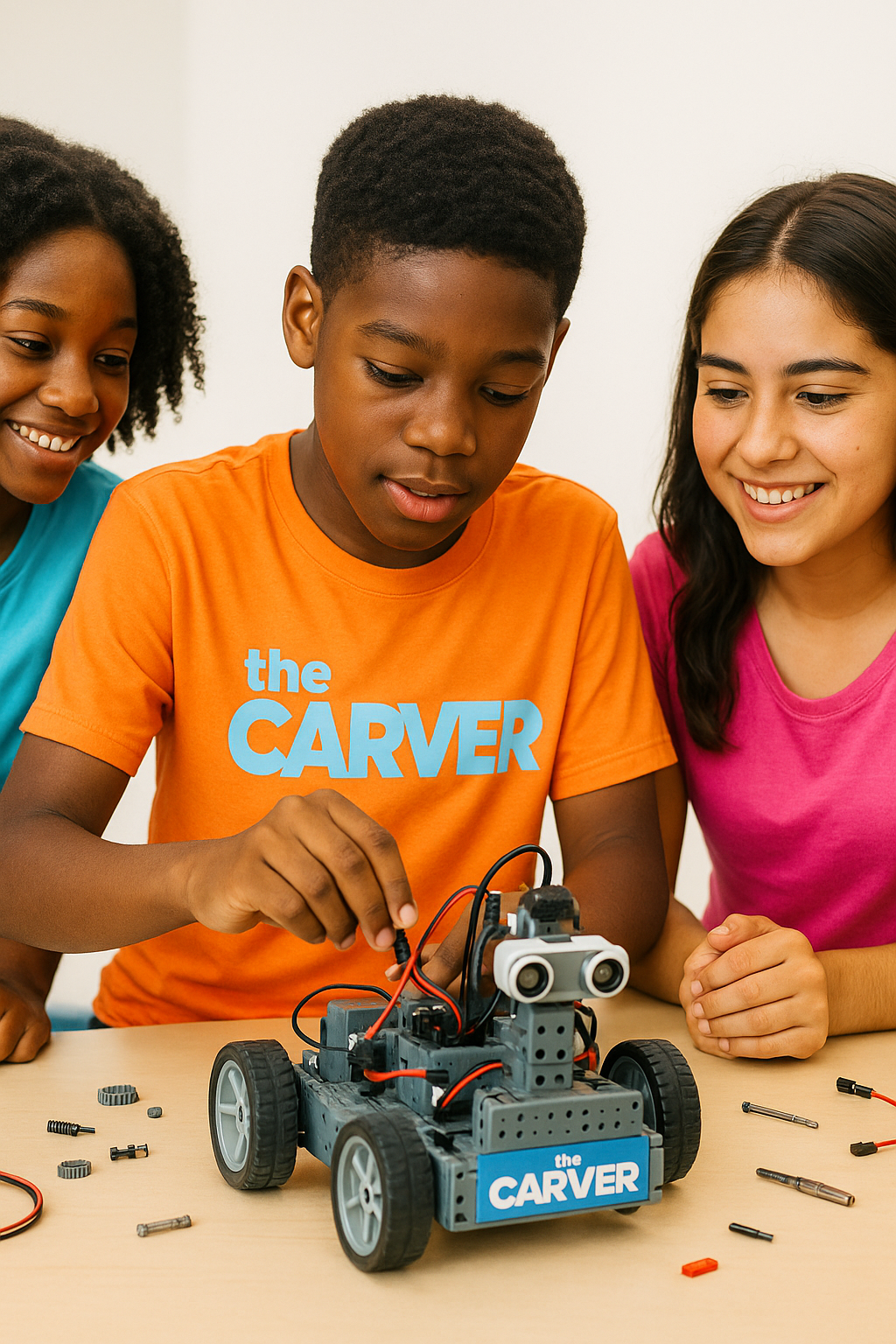
Garavel Subaru has expressed interest in finding ways to engage directly with Carver students, including potentially hosting students to learn about automobiles, the dealership, and careers in the automotive industry. That kind of real-world exposure fits beautifully with Carver's growing emphasis on helping young people explore careers, develop practical skills, and encounter professionals and workplaces beyond the classroom.
We are deeply grateful to Garavel Subaru, its employees, and everyone who participated in the July campaign. Their generosity demonstrates something Carver students experience again and again: when businesses, schools, families, and community organizations come together around young people, opportunities grow.
Thank you, Garavel Subaru, for making Carver students part of your Love Promise.