
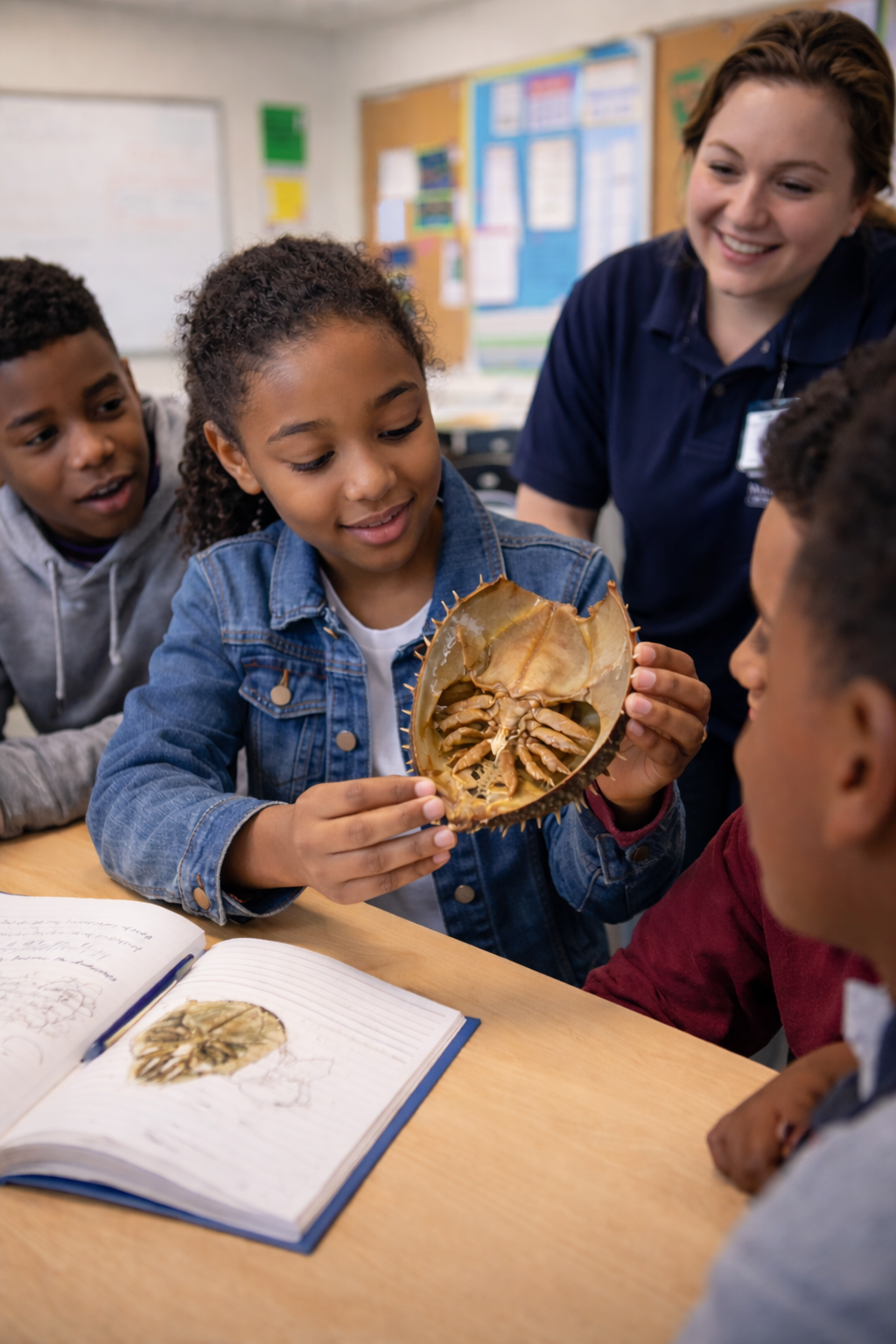
When seventh-grader Elana carefully lifted a horseshoe crab shell from the table, the room went quiet. “This was alive?” he asked, turning it over in his hands. Around him, his classmates leaned in as a Maritime Aquarium educator guided them through the animal's anatomy and its role in Long Island Sound. Within minutes, Jayden was sketching the shell’s shape in his notebook, asking how pollution affects marine habitats, and debating with a classmate about how ecosystems stay balanced.
This wasn’t a field trip. It was a Carver after-school afternoon.
Through our longstanding partnership with The Maritime Aquarium at Norwalk, Aquarium educators bring Marine STEM programming directly into our middle school classrooms. Designed for grades 5–8, these sessions use live animals, biofacts, and hands-on experiments to make marine science tangible and relevant. Students explore plankton's structures, examine marine food webs, and see firsthand how science, technology, engineering, and math connect to the environment just beyond our shoreline.
The programs unfold over multiple weeks, allowing ideas to build and curiosity to deepen. Rather than simply hearing about science, students practice observation, critical thinking, and evidence-based reasoning. The result is engagement that feels immediate and real.
For many Carver students, this exposure expands the ways STEM can look. It reinforces classroom learning while sparking new interests and confidence. Science becomes less abstract and more personal, something they can see, touch, question, and understand.
We are especially proud that Carver CEO Novelette Peterkin serves on The Maritime Aquarium’s Board of Directors, reflecting the strong alignment between our missions and our shared commitment to educational opportunity in Norwalk.
At Carver, after-school programming is structured and intentional. By bringing partners like The Maritime Aquarium into our classrooms, we ensure that students not only strengthen their academic skills, but also discover the wonder of learning — sometimes by holding a horseshoe crab shell in their hands.